
Tanzanite Rings: How to Choose an Investment-Grade Piece
Tanzanite is the only major gemstone with an expiry date. The world's entire supply comes from a single four-square-kilometer site at the foot of Kilimanjaro, and geologists broadly agree the accessible deposits will be exhausted within a generation. For a maison built on colored stones, and for a founder who spent her first career in finance, that makes the tanzanite ring one of the most interesting acquisitions in fine jewelry today: a piece you buy for its beauty, with scarcity built in.
This guide covers what actually determines whether a tanzanite ring is investment-grade, and how we approach it in our own atelier.
What Makes a Tanzanite Worth Setting
Color first, always
Tanzanite ranges from pale lavender to a deep, velvety blue-violet. Value concentrates almost entirely at the saturated end. The stones we select show strong blue with violet fire, vivid enough to read across a dinner table. A pale tanzanite, however large, is a pretty stone; a saturated one is an asset.
The color shift is the signature
Tanzanite is strongly pleochroic: it shows blue in daylight and leans violet under warm evening light. This is not a flaw, it is the reason collectors love the stone. A ring is the best format to experience it, because your hand moves through more lighting conditions in a day than any other piece you wear.
Price logic
Fine tanzanite still trades well below blue sapphire of comparable quality, despite being roughly a thousand times rarer in the ground. We broke down the full economics in our tanzanite price guide, and if you are weighing the two stones against each other, our tanzanite vs blue sapphire comparison settles the question in detail.
The Setting: Why 18K Gold and a Sapphire Halo
Tanzanite measures 6.5 to 7 on the Mohs scale: durable enough for a ring worn with intention, softer than sapphire or diamond. The setting therefore matters more than with harder stones. We set tanzanite in 18K gold with a protective surround of blue sapphires, which does two things at once: it shields the center stone's girdle from daily knocks, and it deepens the blue story of the piece.
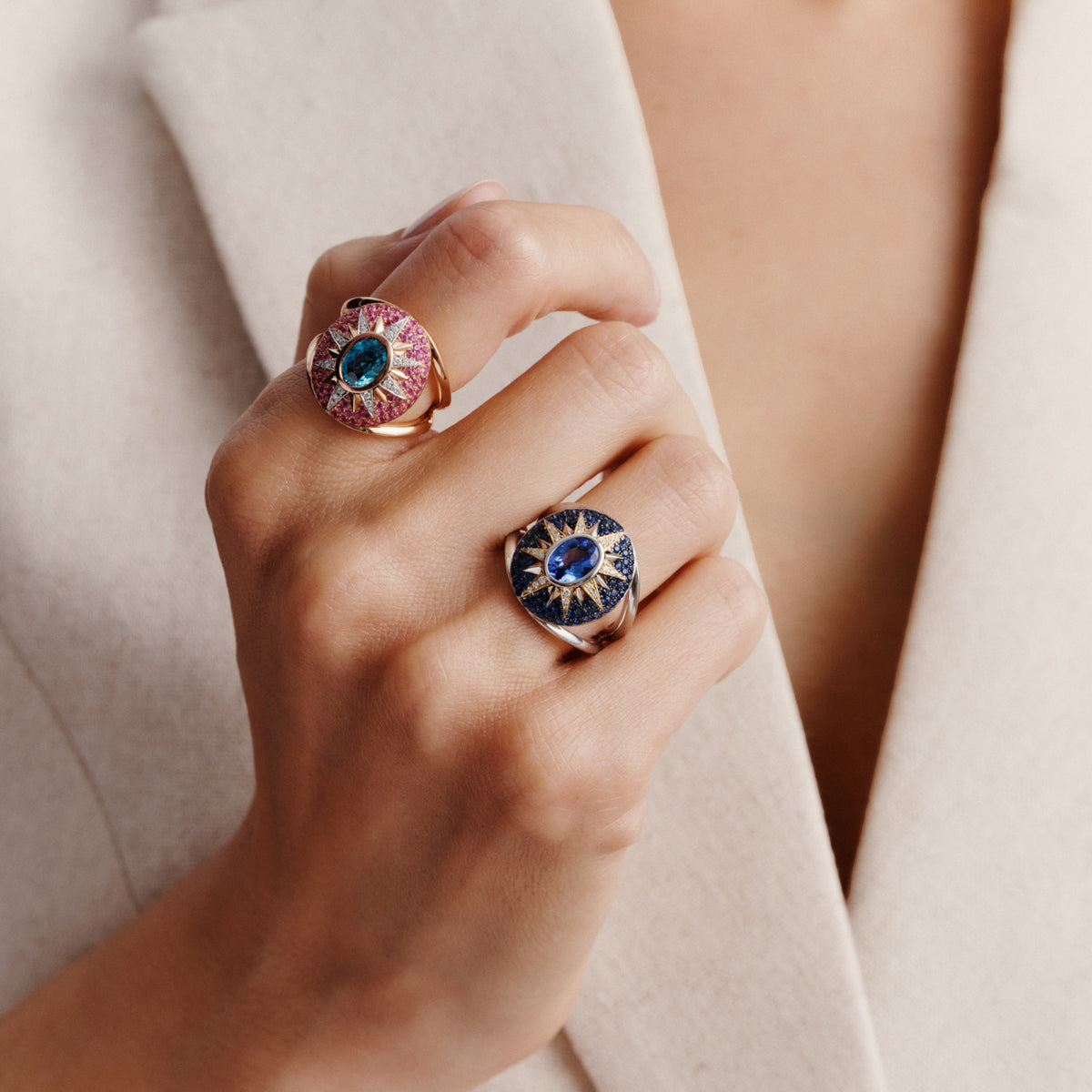
That is the architecture of the Crush Nova Ring in tanzanite and blue sapphires: a saturated tanzanite center, a halo of fine blue sapphires, sculpted in 18K gold. It is, year after year, the most requested piece at our appointments.
Building the Tanzanite Story Beyond the Ring
Collectors who fall for tanzanite rarely stop at one piece. The Crush Nova Pendant carries the same stone at the collarbone, and the Crush Nova Earrings in tanzanite and blue sapphires complete the suite. Worn together, they read as one deliberate color statement; our full tanzanite collection gathers every piece.
For the stone's full story, from its 1967 discovery to why Tiffany named it, read the Story of Tanzanites in our gem library.
A Note on Certificates and Care
Every tanzanite piece we sell ships with its certificate of authenticity. Care is simple: warm soapy water and a soft cloth, never an ultrasonic cleaner. Remove the ring for sport and heavy housework, as you would any fine colored stone. Full instructions are in our cleaning guide for 18K gold and gemstone jewelry.
See the Color Shift for Yourself
No photograph has ever done tanzanite justice; the stone must be seen moving through light. Book a private appointment at the Ritz Paris and compare our tanzanites side by side, from daylight to candlelight. International clients receive worldwide shipping, free of charge, taxes and duties included.