Tsavorite vs Emerald: The Green Garnet Worth Knowing
When it comes to green gemstones, emerald has reigned for centuries. But connoisseurs increasingly turn to a less famous and remarkably vivid alternative. Comparing tsavorite vs emerald reveals two very different stones: one a legendary beryl known for its velvety green and characteristic inclusions, the other a rare garnet admired for its brilliance, clarity and durability.
This guide compares the two on origin, color, brilliance, durability, treatments and value, to help you choose the green stone that suits you.
What Is Tsavorite?
Tsavorite is a green variety of grossular garnet, colored by vanadium and chromium. It was discovered in East Africa in the late 1960s and became known to the public in the 1970s, when it was named after the Tsavo region of Kenya, where important deposits were found. It remains a relatively rare gemstone, and fine stones above a few carats are particularly uncommon.
Many people associate garnets with dark red stones, but the garnet family is surprisingly diverse. Tsavorite is one of its most precious members, alongside the orange spessartite garnet.
What Is Emerald?
Emerald is the green variety of beryl, colored by chromium and sometimes vanadium. It is one of the most celebrated gemstones in history, prized since antiquity. Emeralds almost always contain inclusions, affectionately called the "jardin", or garden, which are considered part of the stone's character.
Tsavorite vs Emerald: Side-by-Side Comparison
Color
Both stones can display an intense, saturated green. Emerald typically shows a slightly bluish green with a soft, velvety look. Tsavorite ranges from fresh spring green to deep forest green, often with a slightly yellowish undertone and a more vivid, luminous appearance.
Brilliance
This is where tsavorite shines. Its refractive index is significantly higher than emerald's, which gives it far more brilliance and sparkle. Emerald's beauty lies in its depth and velvety glow rather than in sparkle.
Clarity
Tsavorite is typically much cleaner than emerald. While emeralds are expected to show visible inclusions, fine tsavorites often appear clean to the naked eye, which contributes to their brilliance.
Durability
Emerald has a hardness of 7.5 to 8 on the Mohs scale, but its frequent inclusions make it relatively brittle and sensitive to shocks. Tsavorite, at around 7 to 7.5, has no cleavage and good toughness, which makes it more resistant to everyday wear than its hardness alone suggests.
Treatments
Most emeralds are treated with oils or resins to improve their clarity, a traditional and accepted practice that nevertheless requires care, since the filling can be affected by heat, solvents or ultrasonic cleaning. Tsavorite is generally untreated, which is one of its most appreciated qualities among collectors.
Rarity and Price
Fine emeralds, especially larger stones with minimal treatment, command very high prices. Tsavorite is rare, particularly in larger sizes, but at equivalent quality it generally remains more accessible than a comparable emerald. It offers excellent value for those who want an intense green with outstanding brilliance.
Which Green Stone Should You Choose?
Choose Emerald If
You are drawn to history and legend, you love the velvety, slightly bluish green and the character of its inclusions, and you are ready to wear it with care, ideally in pendants and earrings.
Choose Tsavorite If
You want a vivid, brilliant green that sparkles, a stone that is usually untreated and more resistant to daily wear, and a gem that is still a discovery for many people. The Crush Stella pendant in tsavorites is a delicate everyday introduction to this garnet.
Consider Green Sapphire Too
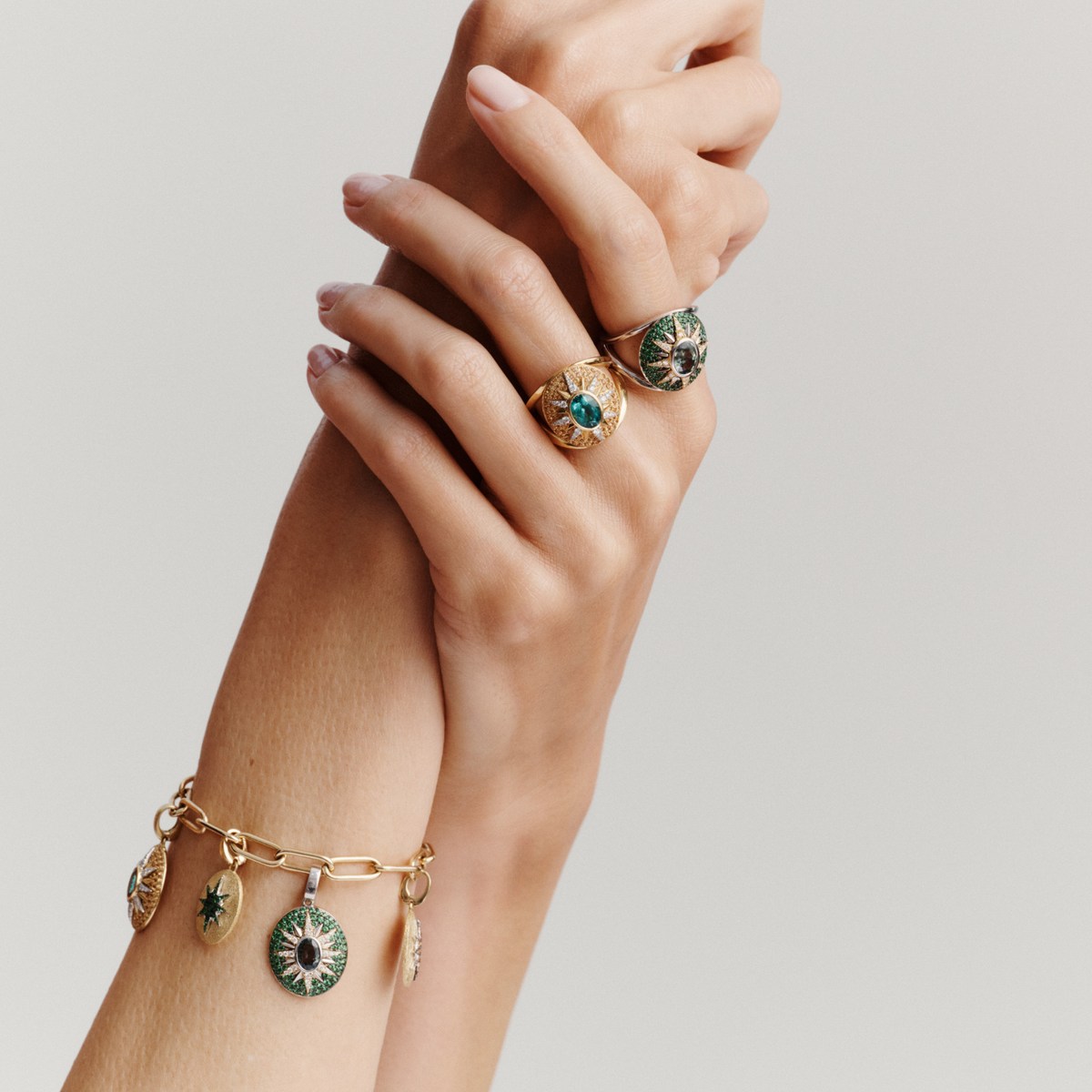
Green sapphire is a third option worth knowing: even harder and ideal for rings, with a more understated teal to forest green. Our guide on green sapphire vs emerald and the story of green sapphires tell you more. Tsavorite and green sapphire are combined in a tonal composition on the Crush Nova ring and the Crush Nova pendant, part of the Crush Nova collection.
How to Wear Green Gemstones
Green is a surprisingly versatile color. It flatters most complexions, pairs well with navy, camel, white and black, and brings a natural, elegant touch to any outfit. Yellow gold warms green stones and emphasizes their vivid character, while white gold gives them a cooler, more modern look; see yellow gold vs white gold for colored gemstones. For more ideas, browse our gold pendants and colorful gemstone rings.
Caring for Tsavorite and Emerald
Tsavorite can be cleaned with lukewarm soapy water and a soft brush. Emerald requires more caution: avoid ultrasonic cleaners, steam, solvents and heat, which can affect the treatments. Store both separately from harder stones. More advice in our jewelry care guide.
Summary
Tsavorite vs emerald is a comparison between legend and brilliance. Emerald, a beryl, offers a velvety bluish green and a storied history but is usually included, often treated and relatively brittle. Tsavorite, a rare green grossular garnet, offers more sparkle, greater clarity, good toughness and is generally untreated, often at a more accessible price. Choose emerald for its heritage and character, tsavorite for its vivid brilliance and everyday resilience.